

From Finding Role Models to Becoming One: How the Qs Emotional Intelligence Programme Empowers Students to Thrive Through Challenge

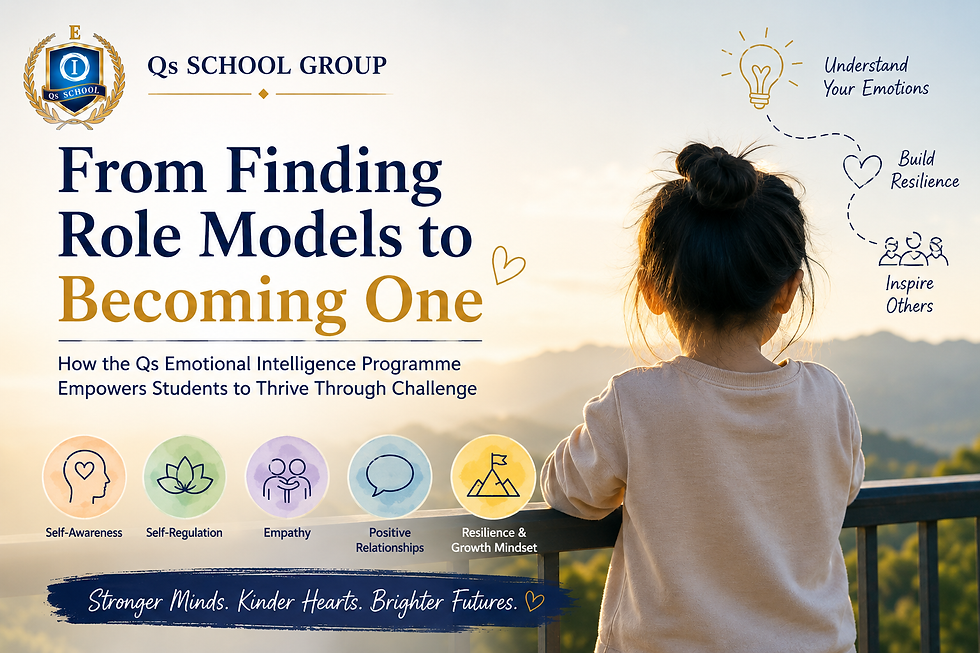
At Qs School, we place strong emphasis on Mindful Education. We believe that a truly powerful learning environment goes beyond academic knowledge—it nurtures inner strength. When students learn to understand themselves and regulate their emotions, they are better equipped to face challenges and conflict with clarity, stability, and resilience.
Learning with Joy: Building Emotional Awareness and Inner Strength
At Qs School, learning happens not only through books, but in every moment where emotions are recognised and respected. We actively support students’ emotional wellbeing by creating classrooms that feel safe, warm, and positive.
When children feel heard and valued, they develop the confidence to grow—not just academically, but emotionally and socially as well.
A New Emotional Intelligence Module: Seeing Emotions, Understanding Self
Recently, our teaching team introduced a newly designed Emotional Awareness and Self-Understanding module to help students:
Gain deeper insight into the sources of their emotions
Learn how to identify, express, and manage different feelings
Build emotional language and emotional awareness
Encouraging students to talk about how they feel is a critical step in developing psychological resilience, self-regulation, and inner stability. Emotions that are seen and understood can be managed with care and confidence.
What Is Emotional Literacy Education?

Emotional Literacy refers to the ability to recognise, understand, and respond to one’s own emotions and those of others. Emotional literacy education is a core capability that lays the foundation for lifelong emotional wellbeing.
Children who grow up in environments where emotions can be named and expressed through intentional emotional literacy education are often better prepared to navigate life’s inevitable challenges.
Understanding and labelling emotions helps students to:
Identify and name feelings
Develop healthy coping strategies
Strengthen problem-solving skills
Support language and writing development
Build trust and emotional connection
Establish strong Emotional Intelligence (EQ)
The Power of Role Models: From Following to Internalising


Role models play a powerful role in shaping how students understand learning—and life itself. As part of the programme, students explored the life story of Australian Paralympic champion and social advocate Dylan Alcott.
Despite using a wheelchair from a young age, Dylan has achieved extraordinary success across sport, education, and public life. His story highlights:
Resilience and optimism in the face of challenge
The ability to regulate emotions during setbacks and disappointment
A growth mindset focused on what is possible, rather than limitations
Through his experiences, students came to understand that true strength lies in how we choose to respond to challenges.
Emotional Reflection: Questions Students Are Exploring
During classroom activities, students engaged in self-awareness and reflective writing by exploring questions such as:
What emotions am I noticing right now, and where do they sit on an emotions chart?
How do these emotions show up in my body?
What recent situations triggered strong emotional responses?
These prompts help children transform feelings into understanding, allowing emotions to become something they can observe, reflect on, and manage.
Teacher Collaboration: Best Practice in Emotional Intelligence Education
Through collaborative planning and reflection, teachers agreed that high-quality Emotional Intelligence education should:
Expand students’ emotional vocabulary, including unfamiliar emotions
Emphasise the value of writing and reflection
Normalise all emotions, including intense or challenging ones
Help students understand the real challenges Dylan Alcott faced
Teach how to reframe negative emotions into positive motivation
Share real-life, relatable examples
Compare situations of managing emotions versus being controlled by them
Guide students to build emotional awareness
Be grounded in current educational and psychological research
Emotional Education Today, Lifelong Impact Tomorrow
Imagine a world where adults are not only knowledgeable, but also emotionally intelligent. By nurturing emotional literacy from an early age, this vision becomes achievable.
Partnering with Families to Build Emotional Resilience
Our teachers will continue working with students to deepen emotional regulation and self-awareness. We also warmly invite parents to extend these conversations at home, sharing reflections and language around emotions together.
The Qs School teaching team remains committed to collaboration and will continue updating our school community on our ongoing journey in Mindful Education and Emotional Intelligence development.
Comments